Why posting limits matter on LinkedIn for creators
Why posting limits matter on LinkedIn for creators

Most LinkedIn content creators assume the path to more visibility is simple: post more, reach more people. It’s a logical assumption that turns out to be wrong in 2026. Understanding why posting limits matter on LinkedIn isn’t just about following platform rules. It’s about protecting your reach, your account standing, and the time you invest in every post you write. The LinkedIn algorithm has shifted dramatically, and the creators who understand its current logic are quietly outperforming those who are still playing a volume game that stopped working years ago.
Table of Contents
- Understanding LinkedIn’s evolving posting algorithm
- How posting too often harms your LinkedIn reach and account health
- Finding the optimal posting cadence for engagement and growth
- Best practices for maintaining safe posting habits and account health
- Why quality and consistency trump volume on LinkedIn in 2026
- Optimize your LinkedIn content strategy with Resonate
- Frequently asked questions
Key Takeaways
| Point | Details |
|---|---|
| Posting frequency impacts reach | Posting too often causes your posts to compete against each other, reducing overall engagement and visibility. |
| Quality beats quantity | LinkedIn rewards high-value, engaging content over frequent superficial posts, leading to better long-term results. |
| Optimal posting is 3-5 times weekly | This posting cadence balances maintaining audience attention with avoiding algorithm penalties for overposting. |
| Account safety depends on behavior patterns | LinkedIn tracks your activity baseline, so sudden spikes or unnatural patterns can cause restrictions even if numeric limits aren’t exceeded. |
| Gradual ramp-up is key | Increasing your posting frequency slowly while monitoring engagement and Social Selling Index helps maintain account health. |
Understanding LinkedIn’s evolving posting algorithm
LinkedIn’s algorithm in 2026 does not reward effort. It rewards outcomes. Specifically, it measures how long people spend reading your post, whether they engage meaningfully, and whether your content sparks genuine conversation. Dwell time, the amount of time a viewer spends on your post before scrolling away, has become one of the strongest signals the algorithm uses to decide how far to distribute your content.
This matters enormously for your posting cadence. High-performing posts generate engagement for 48 to 72 hours after publishing. When you publish a second post before the first has completed its distribution cycle, you effectively pull the algorithm’s attention away from your earlier content. This is called content cannibalization, and it is one of the most common and least discussed reasons why frequent posters see diminishing returns.
“Posting twice a week with genuine insight consistently outperforms posting daily with content that generates no conversation.”
The algorithm also uses semantic analysis now, meaning it evaluates what your post actually says, not just how many people clicked or liked it. Repetitive topics, recycled frameworks, and low-effort updates get deprioritized regardless of how often you post them. This is a meaningful shift from the era when marketing analytics were mostly about volume and click-through rates.
Key things the 2026 LinkedIn algorithm rewards:
- Posts that hold attention for longer than 30 seconds
- Comments that contain substantive replies, not just emoji reactions
- Content that generates saves and shares, not just likes
- Unique angles and perspectives rather than repeated formats
- Engagement that happens within the first 90 minutes of publishing
The takeaway here is that the importance of posting limits is not arbitrary. It is baked into how LinkedIn’s distribution system actually works. Explore LinkedIn content and growth tips if you want to go deeper on how algorithm changes affect your content strategy.
How posting too often harms your LinkedIn reach and account health
The reach damage from overposting is more severe than most creators realize. Two posts from the same creator within a short window split impressions and reduce reach by more than 40%. That is not a marginal dip. That is nearly half your potential audience disappearing because you posted too soon after your last update.

Beyond reach, there is an account safety dimension that gets almost no attention in mainstream content advice. LinkedIn monitors behavioral patterns, not just raw post counts. When your account suddenly spikes in activity, whether through rapid posting, automated likes, or mass connection requests, the platform’s systems flag it as potentially inauthentic. 23% of LinkedIn automation users face account restrictions within 90 days, often because they exceeded safe action thresholds without realizing it.
Here is a practical breakdown of how overposting damages your presence over time:
- Reach fragmentation. Each post competes with your previous posts for the same audience pool. More posts means less reach per post.
- Engagement dilution. Your followers have limited attention. Posting too often trains them to ignore you, lowering your average engagement rate.
- Algorithm penalties. Unnatural posting patterns trigger LinkedIn’s content quality filters, which can suppress your distribution across the board.
- Account restrictions. Accounts showing sudden activity spikes, especially new or recently dormant ones, face a higher risk of being flagged or shadowbanned.
- Credibility erosion. Audiences on LinkedIn notice when someone is flooding their feed. It signals desperation rather than authority.
Pro Tip: If you are using any form of LinkedIn content generator or automation tool, build in mandatory delays between posts and set hard daily limits on all engagement actions. The risk of restriction compounds quickly when multiple automated actions happen in the same session.
New accounts are especially vulnerable. LinkedIn has no behavioral baseline for them, so even moderate activity can look suspicious if it ramps too fast. The same applies to accounts that have been dormant for months and then suddenly become highly active. You can learn more about AI-powered lead generation approaches that account for these risks when building your pipeline.
Finding the optimal posting cadence for engagement and growth
Here is where the data gets specific. 3 to 5 posts per week is the range that consistently produces the best inbound results without triggering content cannibalization or account risk. This is not a guess. It reflects how LinkedIn’s distribution window works and how audience attention actually behaves on the platform.
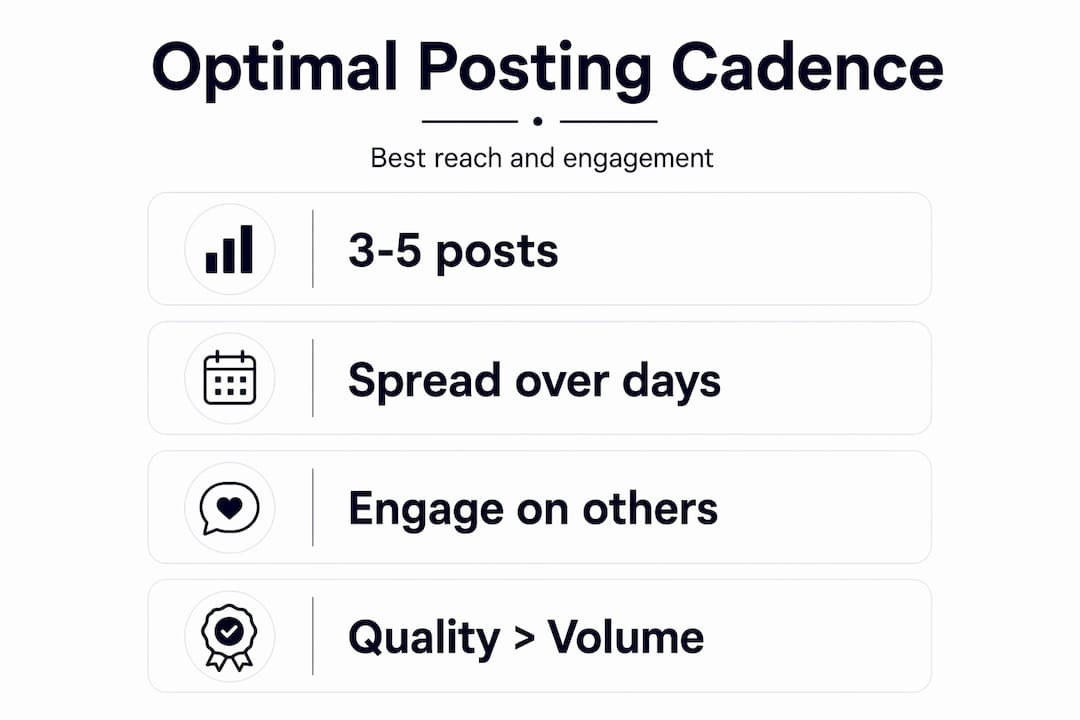
The table below shows how different posting frequencies affect reach and engagement outcomes:
| Posting frequency | Avg. reach per post | Engagement rate | Account risk |
|---|---|---|---|
| 1 to 2 posts per week | Moderate | High | Very low |
| 3 to 5 posts per week | High | High | Low |
| 6 to 7 posts per week | Medium | Declining | Moderate |
| 8 or more posts per week | Low | Low | High |
A few things stand out in this data. First, the sweet spot is not the maximum. More posts per week does not equal more total reach. Second, lower frequency (1 to 2 posts per week) can work well for new accounts that are still warming up their activity baseline, but it leaves inbound lead generation on the table for established profiles.
Content format also plays a role in your optimal posting cadence:
- Text posts perform well mid-week and generate the most comments
- Carousels tend to drive saves and shares, making them ideal for Monday or Tuesday publishing
- Short videos get strong early engagement but require more production time, so spacing them out makes sense
- Polls are useful for filling gaps in your schedule without requiring heavy content creation
Pro Tip: Commenting on 5 to 10 posts from others in your niche on the same day you publish your own content significantly boosts your post’s early distribution. LinkedIn reads your engagement activity as a signal that you are an active, genuine participant, not just a broadcaster. Check the LinkedIn posting strategy blog for more tactical guidance on timing and format selection.
Best practices for maintaining safe posting habits and account health
Knowing the right frequency is one thing. Building habits that keep your account safe and your content performing well over months is another. The following steps reflect what actually works for consistent, long-term LinkedIn growth.
- Start slow and build a baseline. New accounts and reactivated profiles should begin with 1 to 2 posts per week. New profiles should monitor their Social Selling Index before scaling activity. Your SSI score (LinkedIn’s internal metric for profile strength and engagement quality) is a useful early warning system.
- Ramp up gradually. Increase your posting volume by no more than 10 to 20% per week. A sudden jump from 2 posts per week to 7 is a red flag to the algorithm, even if each post is high quality.
- Vary your engagement actions. Mix likes, thoughtful comments, profile views, and shares rather than repeating the same action pattern every day. Randomized timing and varied behavior look human. Rigid, repetitive patterns look automated.
- Prioritize the first 90 minutes. Engagement velocity in the window right after publishing is the single biggest factor in how far LinkedIn distributes your post. Have a few genuine connections ready to engage early, or use a community boost feature if your platform supports it.
- Watch your acceptance rates. If you are sending connection requests and your acceptance rate drops below 20%, pause outreach immediately. This signals to LinkedIn that your activity may be spam-like.
- Pause and engage when things feel off. If you notice a sudden drop in reach or receive any account warnings, stop posting for a few days and focus purely on commenting and engaging with others. This resets your activity pattern without abandoning the platform.
Pro Tip: Schedule posts at slightly irregular times rather than on the exact hour. 9:07 AM looks more human than 9:00 AM. Small details like this matter when LinkedIn’s systems are evaluating whether your account behavior is authentic.
Why quality and consistency trump volume on LinkedIn in 2026
Here is the uncomfortable truth that most LinkedIn advice still refuses to say clearly: the volume-based playbook is not just less effective now. It is actively counterproductive. Creators who built large followings between 2020 and 2023 by posting every single day are finding that their reach has collapsed, not because LinkedIn punished them, but because their audiences stopped caring.
LinkedIn’s 2025 algorithm update caused a 50% drop in performance for artificial engagement, rewarding genuine relationships over high-volume posting. That number is staggering. Half the performance, gone, for accounts that were gaming the system rather than building real credibility.
What works now is a fundamentally different mental model. LinkedIn in 2026 functions more like relationship marketing than broadcast marketing. The creators winning on the platform are not the ones with the most posts. They are the ones whose posts generate real conversations, whose comments are worth reading, and whose presence feels like a person rather than a content machine.
This shift has a practical implication for how you think about your content strategy for LinkedIn. Instead of asking “how do I post more,” the right question is “how do I make each post worth waiting for.” A post that generates 50 genuine comments from people in your target audience is worth more than 10 posts that each get 3 likes. Not just for your ego, but for your actual reach, your inbound leads, and your account’s long-term standing.
The deep LinkedIn insights on this topic consistently point in the same direction: early engagement velocity, authentic voice, and consistent (not constant) presence are the three variables that actually move the needle. Volume is not on that list.
Optimize your LinkedIn content strategy with Resonate
Understanding posting limits is only half the equation. Executing a consistent, high-quality content strategy within those limits is where most creators struggle.
Resonate is built specifically for this challenge. It trains on your individual voice and writing style, pulls ideas from your actual work tools like Notion, Slack, and HubSpot, and helps you publish content that sounds like you, not a generic AI. Its built-in safety guardrails and configurable posting limits mean you can automate your LinkedIn workflow without risking your account. Community boost features amplify your posts in the critical first 90 minutes after publishing, giving each piece of content the engagement velocity it needs to reach further. Visit the LinkedIn content marketing blog to see how other creators are applying these strategies in practice.
Frequently asked questions
What happens if I post too frequently on LinkedIn?
Posting too often causes content cannibalization, where your newer posts pull distribution away from older ones. Multiple posts quickly can reduce total impressions by over 40%, meaning your overall reach shrinks even as your posting volume increases.
How many posts per week are optimal for LinkedIn success?
The data consistently points to 3 to 5 posts per week as the range that maximizes visibility and engagement. 3 to 5 weekly posts delivers strong inbound results without triggering reach cannibalization or account risk signals.
Why do LinkedIn accounts get restricted even if posting limits aren’t exceeded?
LinkedIn evaluates your behavior relative to your account’s established activity baseline, not just against fixed numeric thresholds. Activity patterns relative to baseline matter as much as raw counts, so sudden behavioral changes can trigger restrictions even when you are technically within limits.
How can I safely increase my LinkedIn posting frequency?
Start at 1 to 2 posts per week and increase gradually, no more than 10 to 20% per week. New profiles ramping gradually while monitoring their Social Selling Index avoid the sudden spikes that trigger platform flags.
Are automated likes and comments safe on LinkedIn?
Context-aware automated engagement that varies naturally is far safer than bulk cold outreach or repetitive messaging. Automated commenting is high-risk when it lacks context, but engagement automation that mirrors genuine behavior aligns better with LinkedIn’s platform goals than aggressive outreach tactics.